Engineering Design & Prototyping
Design & Modelling / Prototypes / Heavy Vehicle Engineering
Engineering design, reverse engineering and prototyping for heavy vehicles and equipment.
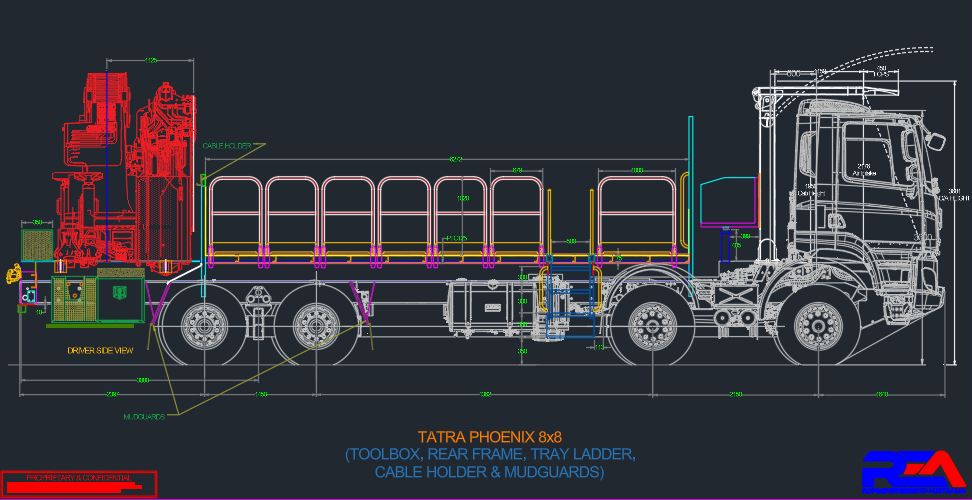
Engineering design and prototyping is the stage where an operational requirement becomes something that can actually be built. REA develops that path in-house, from initial concept through CAD modelling and analysis to a tested prototype, so a design is proven against its real operating conditions before it reaches the workshop floor.
Few projects arrive fully specified. More often there is a problem to solve: a vehicle or piece of equipment that needs to perform outside its original design envelope, a component that is obsolete or worn beyond repair, or a configuration that no longer suits the duty it is being asked to do. REA’s engineering team translates that into a defined, manufacturable design, developed and proven at our Forrestdale, WA facility.
When to contact ROPS Engineering
Where design & prototyping applies
- When an existing truck or piece of equipment must be modified for a specific application or duty
- When an idea, sketch or reference needs to be developed into a manufacturable design
- When an existing component or configuration no longer meets the operating requirement
- When an obsolete, worn, or unavailable part needs to be reverse engineered and reproduced
- When a proven solution needs docmenting and replication across a fleet to a sing specification.
In-house engineering design and CAD
REA maintains its own drafting and design capability. The engineers who scope a requirement also produce the 3D CAD model the work is built from, which keeps design intent intact from brief to finished component. Every design is developed for manufacturability against REA’s own fabrication capability, so what is modelled can be produced, and the transition from drawing to workshop does not depend on a third party interpreting someone else’s files.
Reverse engineering
Where no drawings or original specifications exist, REA reverse-engineers the component from the physical part. The geometry is captured and modelled, and where the application warrants it the design is improved to address the wear or failure mode that brought the part in, then reproduced. This is a common route for obsolete or superseded components on older heavy vehicles and equipment, where the original part is no longer available.
Analysis & Validation
Where a design carries structural or fatigue load, REA validates it before anything is cut. Finite Element Analysis is carried out in-house through SolidWorks Simulation, so stress, deflection and load cases can be assessed at the design stage rather than discovered in service. Where a project requires formal, independent engineering or certification, REA engages an external engineer or certifier as part of the process, so the design is signed off by the appropriate authority without the client having to coordinate it separately.
Prototyping & fleet replication
Once the design is settled, REA can build a working prototype and test it against the actual operating requirement. This matters most for fleet work: a solution is proven on a single unit, refined if needed, then replicated to an identical specification across the remaining vehicles. Every unit is then built to the same validated design, which is what keeps a fleet consistent to operate, maintain and certify.
Design & Prototyping FAQ
Do I need drawings before I contact REA?
No. Many projects begin from a concept, a reference or a physical part. Producing the engineering design is part of the service.
Can REA design from an idea or reference photographs?
Yes. Developing a manufacturable design from a concept, reference or existing configuration is routine work.
Can REA work from our existing CAD files or drawings?
Yes. Where you hold CAD data or drawings, REA works from them or adapts them.
Can REA reverse-engineer an existing component?
Yes. Where no current drawings exist, REA captures the geometry from the physical part, models it and reproduces it, improving the design where the application warrants.
Do REA manufacture everything onsite?
Yes. Design, prototyping and fabrication are all in-house, so a project runs from concept to a finished, fitted result without changing hands.
Can a design be replicated across our fleet?
Yes. Developing a solution once and replicating it to a single specification across a fleet is a core part of how REA works.
Does REA carry out FEA or design simulation?
Yes, in-house through SolidWorks Simulation where a project requires it, with independent certification arranged when it is needed.